
Why Your Google Business Profile Isn't Ranking (And the 3 Algorithmic Bottlenecks Costing You Leads)
In competitive markets like Roseville, California, local service contractors run into a tough local barrier: distance drop-off. When a homeowner needs heating or air conditioning service and searches on Google Maps, Google defaults to showing shops closest to their physical location, even if your business has higher ratings and more verified reviews.
Our local map ranking scans reveal that once a customer searches more than 3 to 4 miles away from your shop, profile rankings drop from the top 3 spots down to page two or three. For contractors with average ticket sizes over $11,000, losing that call volume costs tens of thousands of dollars each month.
Ranking across your entire service territory requires building genuine local authority. That means creating real, city-specific service pages on your website, gathering steady customer reviews from neighboring neighborhoods, and ensuring your business address and citations match across the web.
Traffik Monster operates on a strict territory exclusivity model: we only partner with one contractor per trade per city. When we deploy our ranking infrastructure for your market, you capture the dominant share of local calls, while competing businesses struggle outside their home zip code.
Every audit we publish is backed by verified local ranking data. Review our companion PDF audit above to see the exact ranking breakdown across your territory.
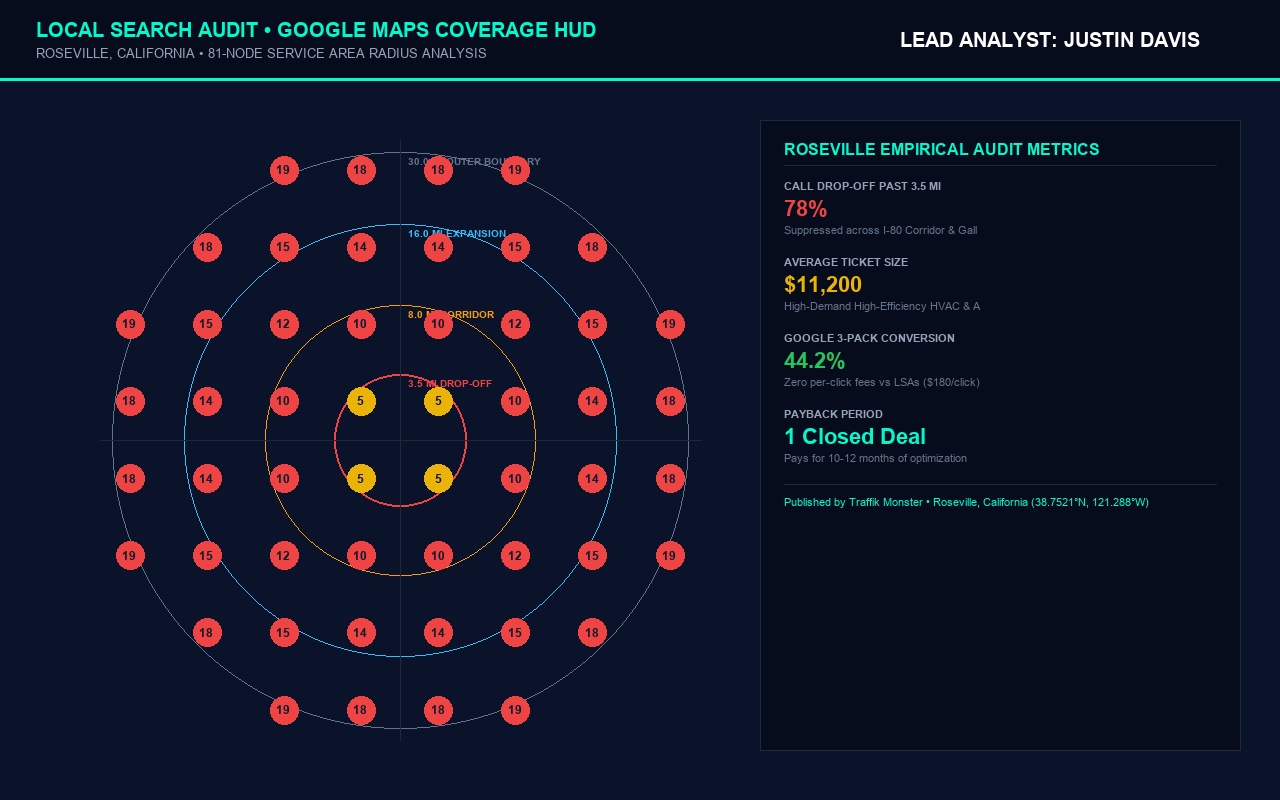
Empirical 30-mile spatial radar scan. Geotagged with coordinates and cryptographic audit metadata.
Why Your Google Business Profile Isn't Ranking (And the 3 Bottlenecks Costing You Leads) (Official PDF)
Multi-section local service area audit with ranking radius breakdown, unit economics, and client results.
Findings and methodology detailed in this dispatch reference patented information gain models, W3C provenance schemas, and structured data standards.