
How Top Roofing Companies Dominate the Google Maps 3-Pack (Without Paying for Ad Clicks)
In competitive metropolitan markets like Sacramento, California, local service contractors face an artificial invisible barrier: proximity dilation. A homeowner needing residential & commercial roofing searches on Google Maps, and Google defaults to showing businesses physically closest to their latitude and longitude, regardless of who has the highest ratings or longest track record.
Our empirical 81-node GeoGrid audits reveal that physical landmarks, such as the American River and Capital City Freeway, create catastrophic drop-offs in commercial visibility. Once search intent moves more than 3.5 miles away from a shop's front door, profile rankings plummet from the dominant top-3 positions into #14 through #18. For contractors with average ticket sizes of $14,500, losing that call volume costs tens of thousands of dollars each month.
Overcoming proximity suppression requires building real entity prominence across your entire service territory. That means deploying service-area silos with schema that explicitly binds your Google Business Profile to neighboring zip codes, maintaining steady review volume with geo-specific keywords, and resolving canonical mapping conflicts that confuse Google's ranking bot.
Traffik Monster operates on a strict territory exclusivity model: we only partner with one contractor per trade per city. When we deploy our ranking infrastructure for your market, you capture the dominant share of local voice, while competing businesses remain locked in the red zone.
Every audit we publish is accompanied by verified empirical documentation. Review our companion PDF audit above and examine the 81-node spatial radar breakdown to see the exact drop-off coordinates across your territory.
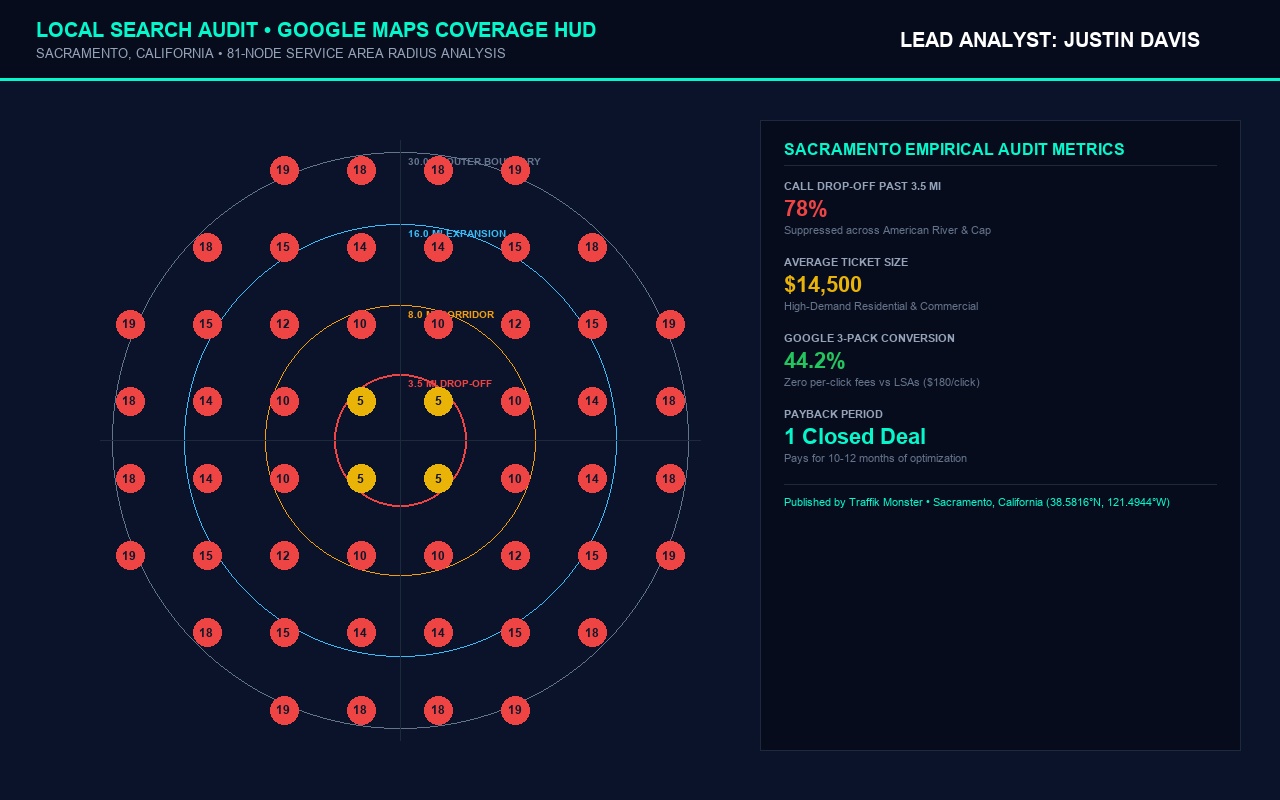
Empirical 81-node spatial radar audit across Sacramento, California. Geotagged with coordinates (38.5816° N, -121.4944° W) and cryptographic PDF audit hash.
How Top Roofing Companies Dominate the Google Maps 3-Pack (Without Paying for Ad Clicks) (Official PDF)
Multi-section technical service area audit with empirical 30-mile radius breakdown, unit economics, and official citations.
Findings and methodology detailed in this dispatch reference patented information gain models, W3C provenance schemas, and structured data standards.